
A combination of reduced cash intensity, a focused strategy of tax administration and GST is the way to go, say Sakshi Gupta, Tanvi Garg and Abheek Barua.

'One way to deal with these is to address these quickly and have rapid reaction teams in New Delhi, the state capitals and wherever possible.'

These consistent performers are expected to maintain momentum.

India grew at 7.6% in 2015-16 and at 7.2% in 2014-15.

The manufacturing sector during the fourth quarter recorded a growth rate of 9.3 per cent while the farm sector grew at 2.3 per cent.

Exchanges believe its legal status may now change, with the government pushing for digitised transactions.

Unless RBI temporarily relaxes the norms on recognising of bad loans, the pressure on this front could rise in the December quarter.

Stricter norms of corporate governance under the Companies Act 2013 as well as increasing application of technology for early detection of frauds through data analysis surveillance and usage of forensic tool are among the other steps taken by the government to prevent fraud by companies, Jaitley said.

'In a nation where safety standards are the lowest in the world, why make compliance expensive?' asks Aakar Patel.

"At present, there are two main rate slabs under which sa majority of goods are covered -- five per cent and 12.5 per cent -- which will now increase to three (five per cent, 12 per cent and 18 per cent).Will this result in multiple litigations is anybody's guess."

The Centre and states are likely to settle for this threshold.

At a meeting of the Empowered Committee of State Finance Ministers, the Centre's plan to bring petroleum goods under GST regime was opposed.

To the extent that body shopping is replaced by true offshoring, everyone is better off, says Ajay Shah.

'It is important to improve the quality of spending.'

How soon can India reach a point when there is no hidden underemployment and all who want work can find it at a fair wage and decent work conditions, asks Nitin Desai.
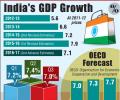
'I expect fourth quarter GDP growth to be sharply down.' 'I would imagine it would shave off at least one percentage point, if not more, as compared to the third quarter.'

The central bank's currency management will be critical over the next few months. A weaker rupee could help to revive exports. But, the currency must fall slowly and in controlled fashion, says Devangshu Datta.

Stocks and sectors impacted most by GST.

Excise exemptions may be whittled in Budget to offset higher govt salaries, pensions

Overseas airlines can operate unlimited number of flights into and out of India.

'The Chinese mindset and approach to India is far different from that in Pakistan.' 'This reality makes it possible for us to follow an engagement policy with one, while militating against engagement with the other.'
'While the GST is structured to be an all-encompassing tax and to create a vastly expanded digital network of recorded transactions, no one knows how traders long used to avoiding taxes will apply their ingenuity,' says T N Ninan.

A combination of farm loan debt waivers by state governments and the implementation of the pay commission award could entail some fiscal slippages and pose a risk to inflation

A moderate GST rate obviates the need for the two-rate structure.

Gujarat has topped with a score of 71.14% on ease of doing business list.

Current Account Deficit is projected at 1.2 per cent and 1 per cent of GDP in 2014-15 and 2015-16.

A quick bounce back of the Chinese stocks looks improbable now.

Stung by the crisis arising out of the Syndicate Bank bribery case, lenders have gone into a fire-fighting mode to avoid fresh bad loans from their exposure to Bhushan Steel, one of the most indebted steel companies in the country.

Airlines likely to be allowed to operate with smaller aircraft.

Significant portion of the funds used to fuel urban demand have become illegal and inoperative.

The Consumer Price Index hit the lowest in six months in March at 4.83 per cent.

The stock market, the Survey felt, had run away from underlying real economy indicators and asked if this indicated rational confidence or irrational exuberance.

The banking sector in India is reeling under Rs 8 lakh crore of non performing assets (NPAs) or bad loans, of which PSU banks alone account for over Rs 6 lakh crore.

It may be the season for corporate matchmaking but India Inc's record of managing partnerships is far from impressive, says Shailesh Dobhal.

A rising number of Greeks in rural areas are swapping goods and services in cashless transactions.


Import growth moderated to a four-month low, owing to sharp decline in that of gold.

In recent past, midcap stocks have performed well, say experts.
Headed by Urjit Patel, MPC for the fourth straight time kept the repo rate unchanged, at which it lends to the banks, at 6.25 per cent. The reverse repo, at which RBI borrows, will be 6 per cent.

GST will yield 'better value for money' for car buyers, increasing automobile industry demand, says Sandip Neogi.
